An in-engine render of the 1948 map with no interface: the coast at Jaffa and Tel Aviv, with sailing boats off Jaffa's breakwater, Tel Aviv's white blocks, a train on the coastal railway, groves, villages and the sub-district borders.
In-engine capture — main 6c54c95, 18 October 2026

Statecraft:Israel

1948–1951

What it is

A turn-based grand-strategy game about governing Israel. You are the prime minister on 15 May 1948. The ministers are the real ones, the map is real, and every historical fact comes with a source.

The game deals with war, terror and the Holocaust as historical events. Its framing is Israeli, and no quotes are invented. It is an early prototype. Sources

In-engine footage

What playing looks like

In-engine capture — main 230042c, 27 October 2026
Real gameplay: 15 May to 15 June 1948. About 19 seconds of real play, recorded from the game's own browser build: a zoom and pan across Tel Aviv, Jaffa and the coastal plain, a click on Tel Aviv that opens its city panel, the One Army and Defence of Degania decisions, and End Turn, which first selects each unit that needs orders. One hard cut leaves out five of the eight units. The video loads from this site when you press play.
In the game

What you do each turn

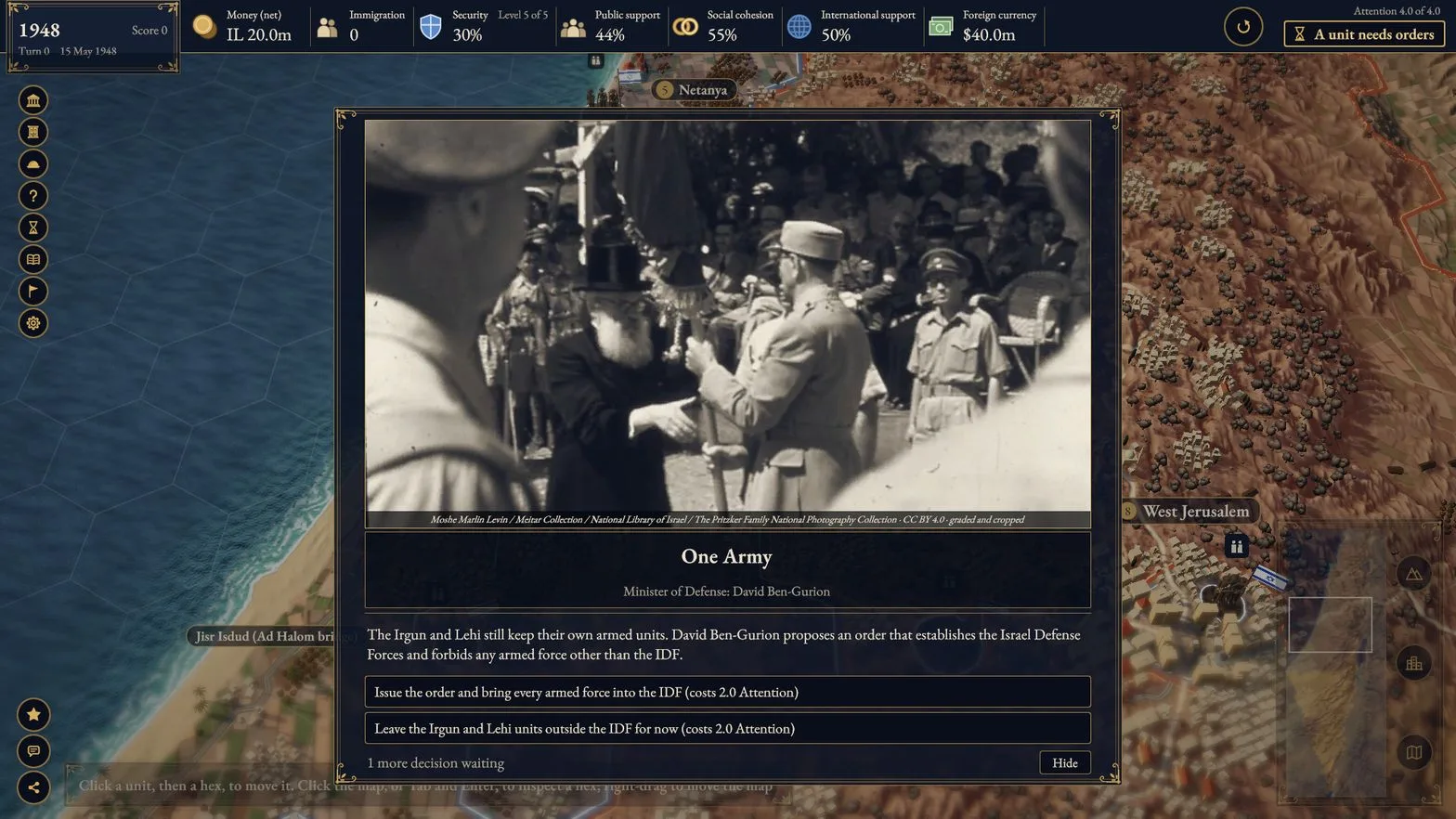
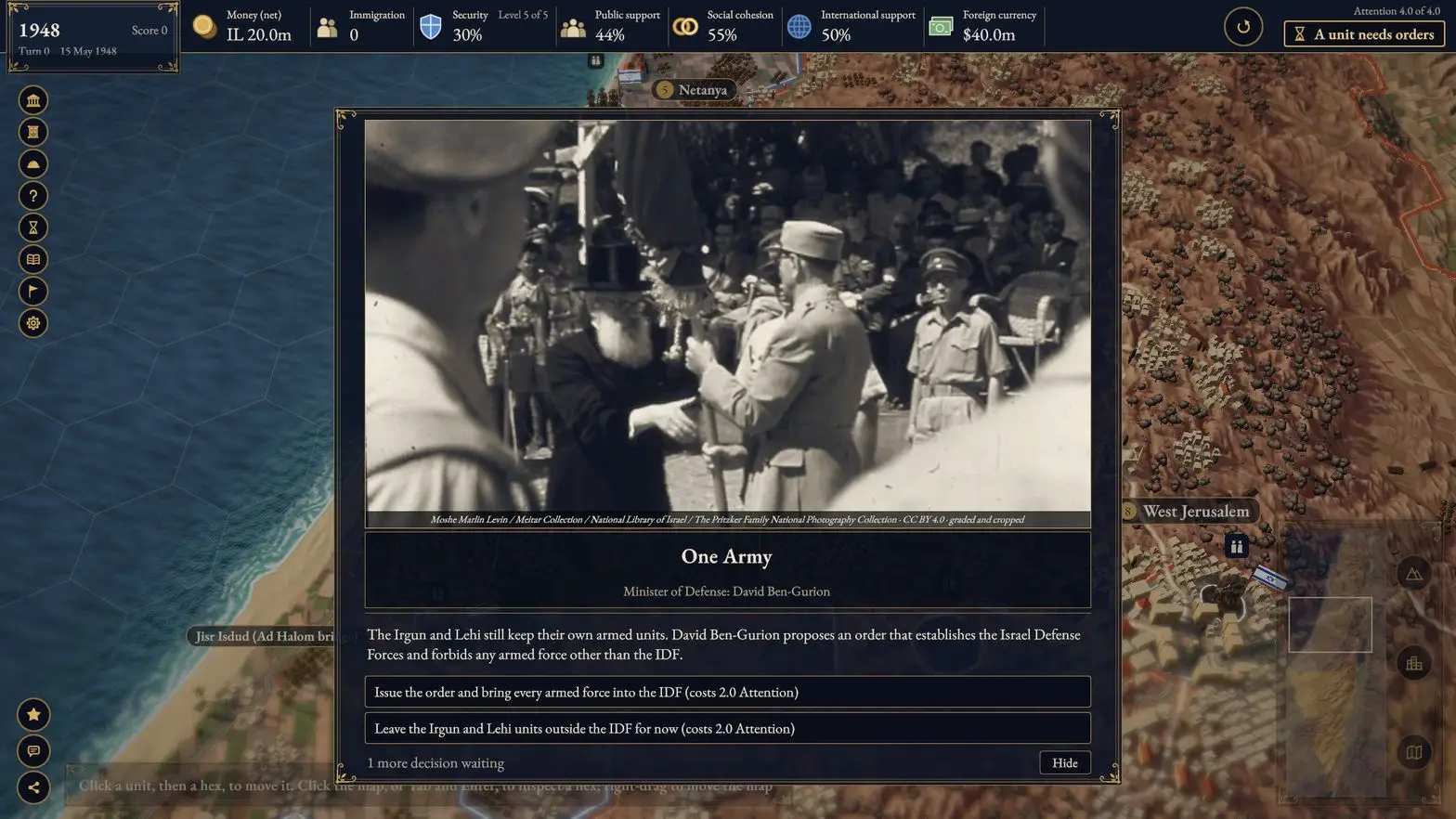
In-engine capture — main 1dca7e0, 27 October 2026The current build, 15 May 1948: the One Army event card with an archival photograph, over the map of the coast, with the top bar, the left icon column and the minimap.
The map, the top bar and an event card · Full size: The map, the top bar and an event card

Real decisions at their real dates

The First Truce, the Altalena affair and the Bernadotte assassination arrive on their real dates, with sources.

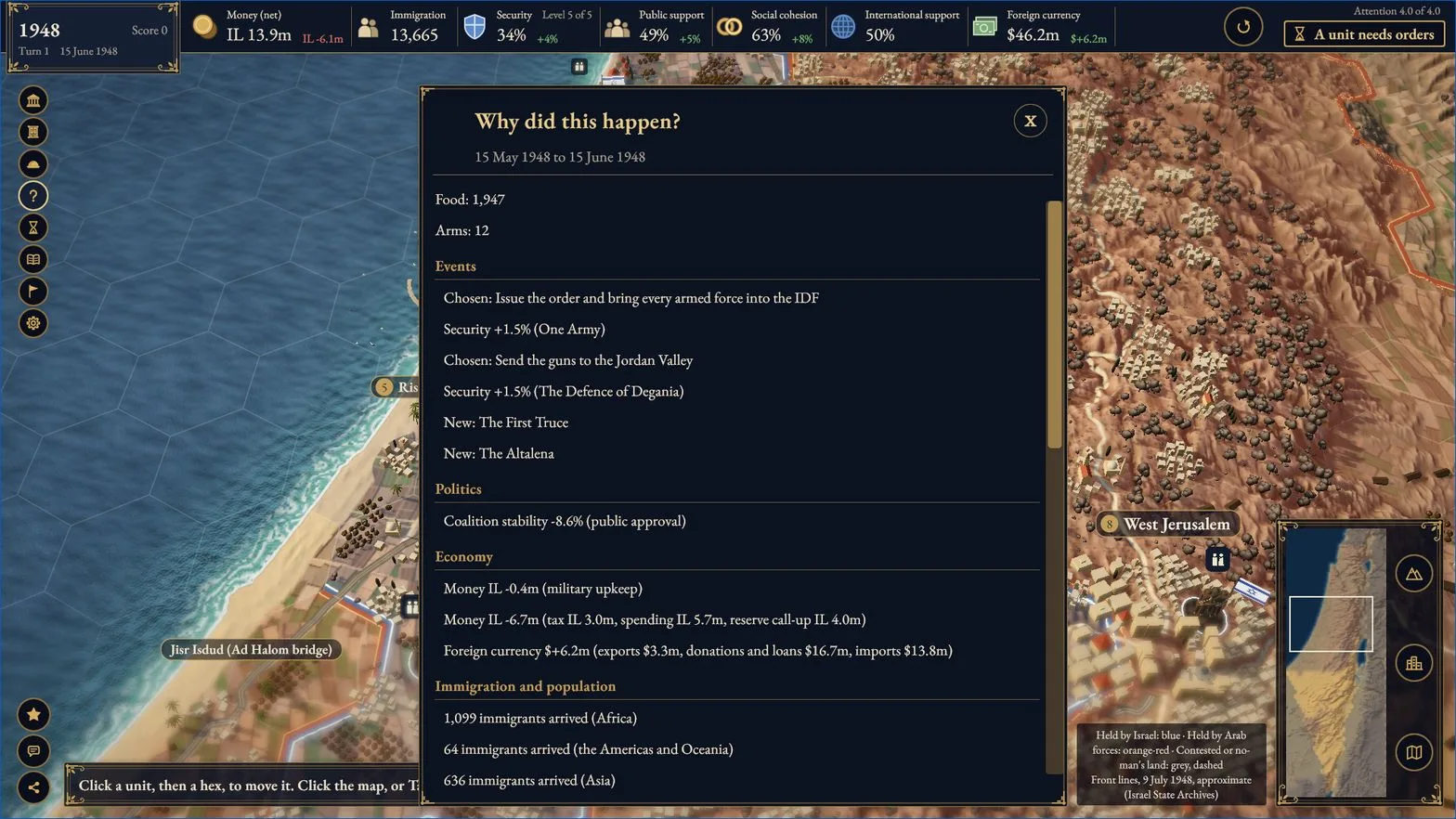
In-engine capture — main 1dca7e0, 27 October 2026The current build, 15 June 1948: the Why panel after the first turn, which lists the choice made, the new events, and the changes to politics, the economy, immigration and the cities, each with its cause.
The “Why?” panel · Full size: The “Why?” panel

Why did that happen?

The “Why?” panel shows what changed each turn, and what caused it.

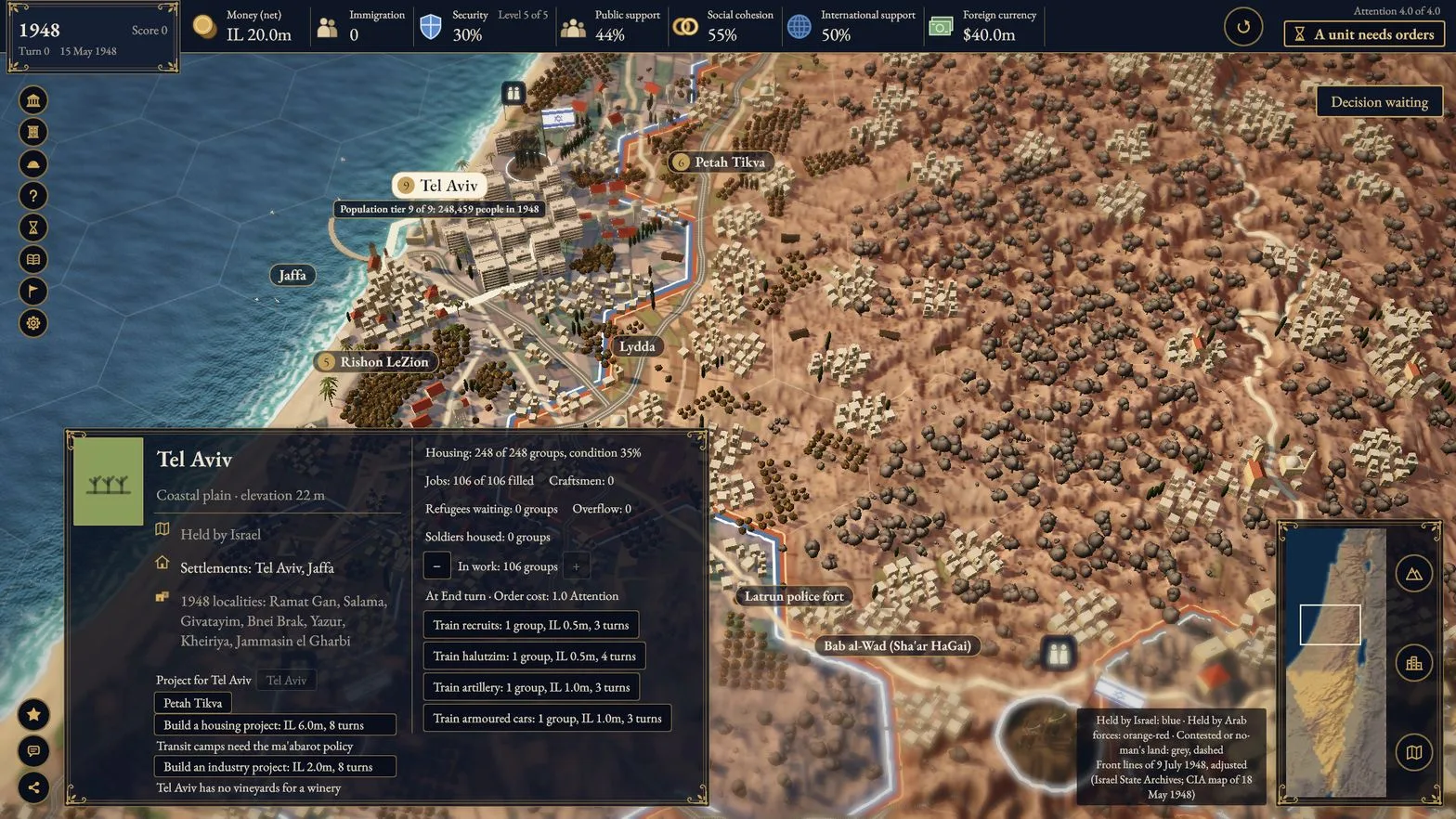
In-engine capture — main 1dca7e0, 27 October 2026The current build, 15 May 1948: a closer look at Tel Aviv, Jaffa, Lydda, Petah Tikva and Rishon LeZion, with groves, villages, railways and roads, the front lines and the top bar, and Tel Aviv's city panel with its housing, jobs, refugees and training.
Tel Aviv and its city panel · Full size: Tel Aviv and its city panel

A map built from real data

The terrain comes from real elevation and rainfall data, and the 1948 railways and roads are traced from maps of the time.

Concept art — AI-generated

The look we are building toward

Concept art made with AI. It is not the current build.

Concept art — AI-generatedAI-generated concept art of the target look: a tilt-shift diorama of the coast around Tel Aviv and Jaffa in 1936, with a top resource bar and an event card. It shows things the game does not have.
The look we are building toward (set in 1936) · A visual target, not the current build · Full size: The look we are building toward (set in 1936)
Cinematic promo — AI-generated, not gameplay

The trailer

Made with AI video tools from our concept art. It is not gameplay.

Cinematic promo — AI-generated, not gameplay
The cinematic trailer. Made with AI video tools from our concept art. It is not in-game footage, and it shows scenes, places and years the game does not have. Music, with quotations of public figures on screen; the captions repeat them. It shows AI likenesses of real ministers and AI scenes of real places; it is not a historical record. The video loads from this site when you press play.
In the open

What is real and what is not

Labels

Every image and video says what it is: an in-engine capture, AI concept art, or an AI promo.

Media

Sources

Every event, minister and date cites its sources. No historian has reviewed the game yet.

Sources

AI use

The code, the concept art and the cinematic trailer were made with heavy AI assistance. The 3D models are by Tal Heuberger. Nothing is generated live while you play.
How we make it

Contributors